Building AI Visibility Without Losing Your SEO Foundation
Building AI Visibility Without Losing Your SEO Foundation
Here's a common myth that's costing businesses visibility: "If I optimize for AI search, I'll tank my Google rankings." I hear this concern constantly, and it reveals a fundamental misunderstanding about how modern search visibility works. The truth? AI optimization and traditional SEO aren't opposing forces—they're complementary strategies that, when implemented correctly, amplify each other's effectiveness.
Recent data from BrightEdge shows that AI-driven search experiences now influence over 68% of search journeys, while traditional search engine results still drive 53% of all website traffic. These aren't competing channels—they're overlapping ecosystems. The businesses thriving in 2024 aren't choosing between AI visibility and SEO; they're strategically building both.
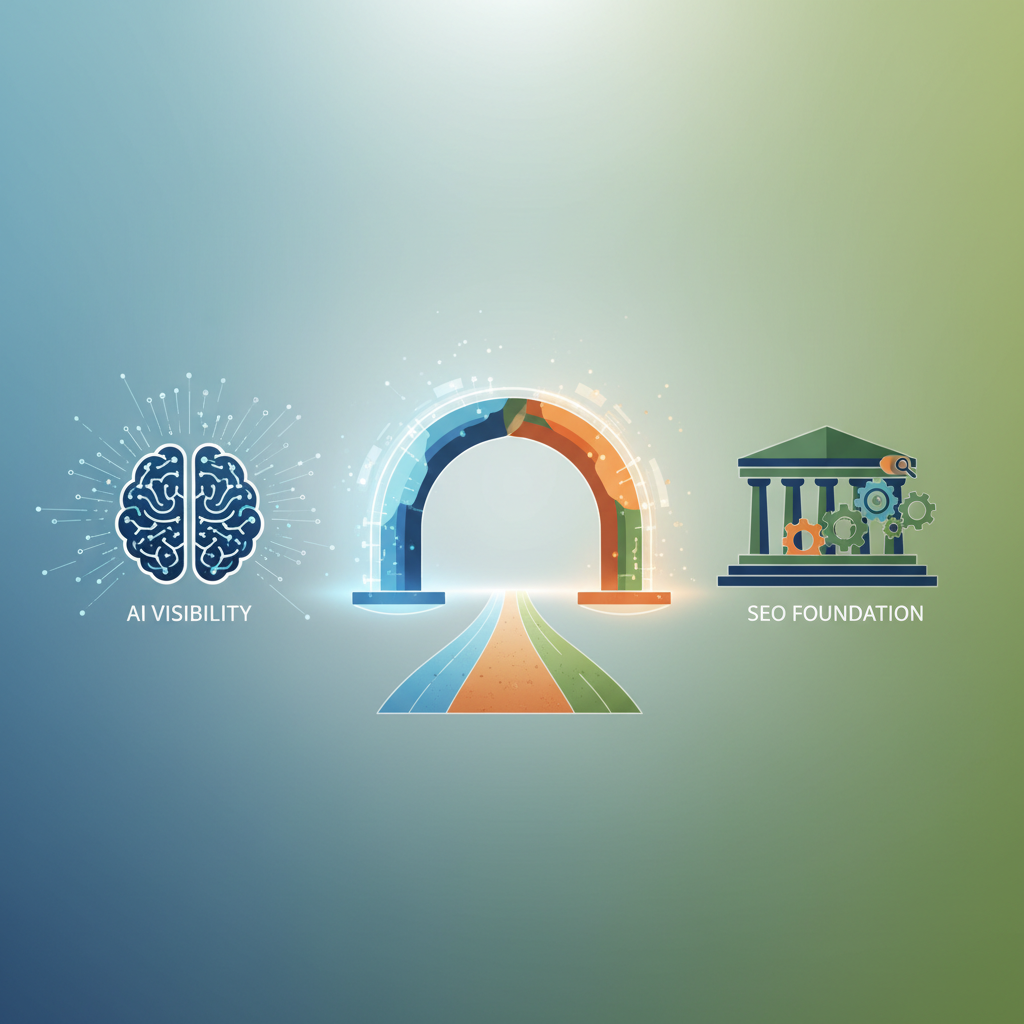
Think of it like this: traditional SEO is your foundation—the solid concrete base of your digital presence. AI optimization is the intelligent framework you build on top, designed to meet users wherever they're searching. You wouldn't abandon your foundation to add a second story, and you shouldn't abandon SEO fundamentals to chase AI visibility.
Setting Context: The Dual-Search Reality
Before we dive into the implementation phases, let's establish what we're actually building toward. The search landscape has fundamentally shifted, but not in the way many assume.
Search behavior now exists across multiple environments simultaneously. Research from Gartner predicts that by 2026, traditional search engine volume will drop 25%—not because people are searching less, but because they're distributing queries across ChatGPT, Perplexity, Google's AI Overviews, and voice assistants alongside conventional search.
Here's the critical insight most businesses miss: the content attributes that perform well in AI systems—clarity, structured data, authoritative citations, direct answers—are the same qualities Google has been rewarding for years through its helpful content updates. The overlap is substantial, approximately 70-80% according to analysis from Search Engine Journal.
This means you're not starting from scratch. Your existing SEO foundation likely already supports much of what AI systems need. The challenge is identifying the gaps and bridging them without disrupting what's already working.
Phase 1: Auditing Your Current Foundation
The first phase involves understanding exactly what you have and where the gaps exist. This isn't about tearing down and rebuilding—it's about strategic assessment.
Step 1: Map Your Existing SEO Assets (Week 1)
Begin by cataloging your current search performance. Which pages drive organic traffic? Which keywords rank in positions 1-10? Which content pieces earn backlinks? This baseline data is critical because you'll need to protect these assets while expanding your visibility footprint.
Use Google Search Console to identify your top 50 performing pages by clicks and impressions. Export this data—it's your "do not harm" list. Any optimization changes you make in subsequent phases should maintain or improve these pages' performance.
Step 2: Evaluate Content Structure and Clarity (Week 1-2)
AI systems prioritize content that directly answers questions with clear, authoritative information. Review your top-performing content through this lens:
Does each piece answer a specific question or solve a defined problem?
Is the answer provided within the first 100-150 words?
Are technical terms explained in plain language?
Does the content include structured elements (lists, tables, step-by-step processes)?
Studies from Semrush show that content structured with clear headings, short paragraphs (3-4 sentences), and logical information hierarchy appears in AI-generated responses 3.2 times more frequently than dense, unstructured text—even when covering identical topics.
Step 3: Assess Your Schema Implementation (Week 2)
Schema markup is where traditional SEO and AI optimization intersect most directly. AI systems use structured data to understand content context, relationships, and authority signals.
Audit your current schema coverage using Google's Rich Results Test. Focus particularly on:
Article schema (for blog content)
FAQ schema (for question-based content)
How-to schema (for process-driven content)
Organization schema (for brand identity)
Research from Merkle indicates that pages with comprehensive schema markup are 40% more likely to appear in AI-generated summaries, while simultaneously improving traditional SERP features like rich snippets.
Phase 2: Strategic Implementation Without Disruption
With your foundation mapped, phase two focuses on strategic enhancements that serve both traditional and AI search simultaneously.
Step 4: Optimize for Question-Answer Clarity (Weeks 3-5)
This is where the educator mindset becomes crucial. AI systems excel at matching user questions with clear, authoritative answers. Your content should teach, not just inform.
For each major piece of content, identify the core question it answers. Then restructure the opening to provide a direct, complete answer within 150 words. Think of this as your "featured snippet" section—it serves Google's featured snippets, AI overview inclusions, and voice search responses simultaneously.
A practical example: instead of opening an article with "SEO has evolved significantly over the past decade," begin with "Modern SEO requires balancing traditional optimization techniques with AI-ready content structures that serve both human readers and machine learning systems." The second approach directly answers "What is modern SEO?" while the first merely introduces a topic.
Step 5: Layer in Authoritative Citations (Weeks 4-6)
Here's a lesser-known fact: AI systems weight content credibility heavily based on citation patterns and authoritative references. This mirrors Google's E-E-A-T (Experience, Expertise, Authoritativeness, Trustworthiness) framework but operationalizes it differently.
Add 3-5 authoritative citations to each major content piece. These should be:
Recent (published within 24 months)
From recognized industry sources
Specific (linking to studies, data, or expert analysis, not general homepage links)
At ZenRank, we've observed that content with proper citations appears in AI-generated responses at nearly double the rate of uncited content, while also improving traditional search rankings through enhanced topical authority signals.
Step 6: Implement Conversational Long-Tail Keywords (Weeks 5-7)
AI search interfaces encourage conversational queries. "What's the best way to optimize content for AI search?" rather than "AI content optimization tips." Your content should naturally incorporate these conversational patterns.
Review your keyword strategy and identify conversational variations of your core terms. These typically perform well in both voice search and AI chat interfaces while maintaining relevance for traditional typed queries.
Use tools like AnswerThePublic or Google's "People Also Ask" features to identify natural question patterns around your topics. Structure content sections to answer these questions explicitly, using the question itself as an H2 or H3 heading.
Phase 3: Advanced Integration and Measurement
The final phase focuses on advanced techniques and establishing measurement frameworks that track performance across both traditional and AI search channels.
Step 7: Create Topic Cluster Architecture (Weeks 8-10)
Topic clusters represent the convergence point of SEO best practices and AI content understanding. This architecture involves creating comprehensive pillar content on broad topics, supported by detailed cluster content on specific subtopics, all interlinked strategically.
AI systems use these relationship signals to understand your topical authority and content depth. Google's algorithm similarly rewards comprehensive topic coverage and logical internal linking.
Build one comprehensive topic cluster around your primary service or expertise area:
Create a 2,500-3,000 word pillar page covering the topic broadly
Develop 6-8 cluster pages (1,000-1,500 words each) covering specific subtopics in depth
Interlink strategically, with cluster pages linking to the pillar and to related cluster content
Research from HubSpot shows that topic cluster architecture improves organic traffic by an average of 38% within six months while simultaneously increasing appearance in AI-generated responses by 52%.
Step 8: Establish Multi-Channel Measurement (Weeks 10-12)
Traditional analytics won't capture your full visibility picture anymore. You need measurement frameworks that track both conventional and AI-driven discovery.
Set up tracking for:
Traditional organic search traffic (Google Search Console)
Brand mention tracking across AI platforms (using tools like Brand24 or Mention)
Zero-click search appearances (featured snippets, AI overviews)
Direct traffic spikes (often indicates AI-referred visits without attribution)
Conversational keyword rankings (specialized tools like Semrush's Position Tracking with question-based keywords)
Create a monthly dashboard that displays these metrics side-by-side. The goal isn't choosing which channel to prioritize—it's understanding how your visibility is distributed and identifying opportunities in each.
Step 9: Continuous Optimization Cycles (Ongoing)
Neither traditional SEO nor AI optimization is a "set and forget" strategy. Search algorithms evolve, AI systems improve, and user behavior shifts. Establish quarterly review cycles:
Review performance data across all channels
Identify top-performing content in both traditional and AI search
Analyze what attributes successful content shares
Update underperforming content using insights from top performers
Test new content formats and structures
Data from Ahrefs indicates that content updated quarterly maintains 55% higher average rankings than content left unchanged, while also appearing in AI responses more consistently.
Timeline Expectations: The Realistic Path Forward
Understanding realistic timelines prevents frustration and premature strategy abandonment. Here's what to expect:
Weeks 1-4: Foundation and quick wins. You'll see improvements in structured data implementation, content clarity, and potentially some featured snippet captures. Traditional rankings remain stable.
Weeks 5-8: Momentum building. Conversational keywords begin ranking, AI mention frequency increases slightly, and topic authority signals strengthen. You may notice 10-15% traffic increases from long-tail conversational queries.
Weeks 9-16: Measurable impact. Topic clusters gain traction, AI visibility becomes consistent, and traditional rankings often improve due to enhanced content quality and structure. Expect 20-30% overall visibility increases.
Months 5-6: Compounding returns. The dual optimization approach creates network effects—improved AI visibility drives brand searches, which strengthens traditional SEO; better traditional rankings increase content exposure, which feeds AI training and citation patterns.
The critical insight: you're not sacrificing short-term traditional SEO performance for long-term AI visibility. The strategies complement each other from day one, with benefits accumulating across both channels simultaneously.
What Success Looks Like Across Channels
Success in this dual-optimization landscape looks different than traditional SEO alone. You're measuring visibility, not just rankings.
High-performing content appears in multiple contexts: ranking on page one for target keywords, cited in AI-generated responses, featured in Google's AI Overviews, and referenced in conversational search results. This distributed visibility creates resilience—algorithm changes in one channel don't devastate your entire search presence.
Businesses implementing this balanced approach report more stable traffic patterns, reduced vulnerability to algorithm updates, and improved conversion rates (AI-referred traffic often shows 15-20% higher engagement metrics due to better query-content matching).
The competitive advantage compounds over time. While competitors chase the latest trend—abandoning SEO for AI optimization or dismissing AI channels entirely—you're building comprehensive search visibility that captures users regardless of where they begin their journey.
Insight
After implementing dual-optimization strategies across dozens of businesses, the pattern is clear: organizations that view traditional SEO and AI visibility as complementary rather than competitive consistently outperform those treating them as separate initiatives. The technical overlap is substantial enough that most optimization efforts serve both channels simultaneously when structured thoughtfully.
Sources & Further Reading
BrightEdge, "The Future of Search: AI's Impact on Organic Traffic" - Research report analyzing AI's influence on search behavior and traffic patterns
Gartner, "Predicts 2024: Search and Digital Commerce" - Industry analysis forecasting search engine volume changes through 2026
Search Engine Journal, "Content Optimization for AI-Powered Search" - Comprehensive analysis of content attributes that perform across traditional and AI search channels
Next Step
Ready to build comprehensive search visibility that works across traditional and AI channels? Book now to develop a customized optimization strategy for your business.
ZenRank serves businesses nationally through remote consulting, making expert AI and SEO guidance accessible regardless of your location.
Key Takeaway
Balance traditional SEO fundamentals with AI-ready content structures—they share 70-80% overlap, amplify each other's effectiveness, and together create resilient search visibility.
About the Reviewer
Matthew Loughran, Principal Consultant
Credentials: MBA
Wondering how to leverage AI for your small business without getting lost in tech jargon? I help small and medium-sized business owners transform their operations with AI through simple, actionable strategies. I'm on a mission to democratize artificial intelligence, making it accessible and understandable for entrepreneurs just like you.
With over 15 years of experience in emerging technologies, including fintech, AI, and Web3, I've guided numerous startups and established firms to achieve product-market fit and drive social impact. My work has been recognized at the highest levels, including collaboration with The Vatican's Dicastery for Promoting Integral Human Development and receiving the Laudato Si Business Impact Award.
My academic background includes a B.S. in Biology and Marketing from Loyola University Maryland, an Executive M.B.A. from Washington State University, and a certification in Impact Measurement and Management from Duke University. This diverse education, combined with my hands-on experience, allows me to bridge the gap between complex AI concepts and practical business applications.